




India market creation · 0→1 · 1→2 · 2→x

Your product works elsewhere. We make it work in India.

Most companies enter India by setting up a company, hiring a country manager and hoping demand shows up. We do it the other way round: we find your first real Indian buyers, close them, and only then help you build the team and the entity around proven revenue.

Software, hardware, deep tech, industrial, medtech, mobility or consumer - if you sell a product, this applies. You pay a retainer plus a success fee on cash your India business actually collects, and every quarter we show you the value created against the fees you paid.

No entity required to start · No generic market-size decks · Stage gates you can walk away from

Andaman and Nicobar IslandsAndhra PradeshArunachal PradeshAssamBiharChandigarhChhattisgarhDaman and DiuDelhiDadra and Nagar HaveliGoaGujaratHimachal PradeshHaryanaJharkhandJammu and KashmirKarnatakaKeralaLakshadweepMaharashtraMeghalayaManipurMadhya PradeshMizoramNagalandOdishaPunjabPuducherryRajasthanSikkimTelanganaTamil NaduTripuraUttar PradeshUttarakhandWest BengalDELHI NCRMUMBAIPUNEAHMEDABADHYDERABADBENGALURUCHENNAIKOLKATA

0→1

Create

First named buyers

1→2

Prove

Repeatable motion

2→x

Scale

Pan-India compounding

What you pay
A monthly retainer plus a success fee, charged only on cash collected in India
How progress is judged
Each stage passes on evidence - named customers, collected revenue, measured win rates
What you get every quarter
A value ledger: revenue and margin created, fees paid, and the multiple between them

In plain terms

Four steps, in the order they actually happen

No jargon: this is the sequence of work from the first conversation with an Indian buyer to a country business that runs without you.

  1. 1

    Step 1

    Find the wedge

    We name the exact Indian buyer, the trigger that makes them act, and what they will pay for - in live conversations, not desk research.

  2. 2

    Step 2

    Win the first customers

    We run the outreach, the demos and the procurement paperwork until real money lands in your account.

  3. 3

    Step 3

    Make it repeatable

    We turn those wins into a playbook, a pipeline and partners - so results no longer depend on the founder being in the room.

  4. 4

    Step 4

    Scale across India

    Regions, channels, local team and a country P&L, built on a motion that has already been proven to work.

Fortnightly India review in progress: a working group at a table with a named-account sheet and a rising monthly revenue chart on screen, one account circled for decision
Course corrections land in 14 days, not a quarterEvery fortnight your India working group answers the same three questions - which named accounts moved, which objections blocked them, how much cash was collected - with evidence rather than market-size slides.
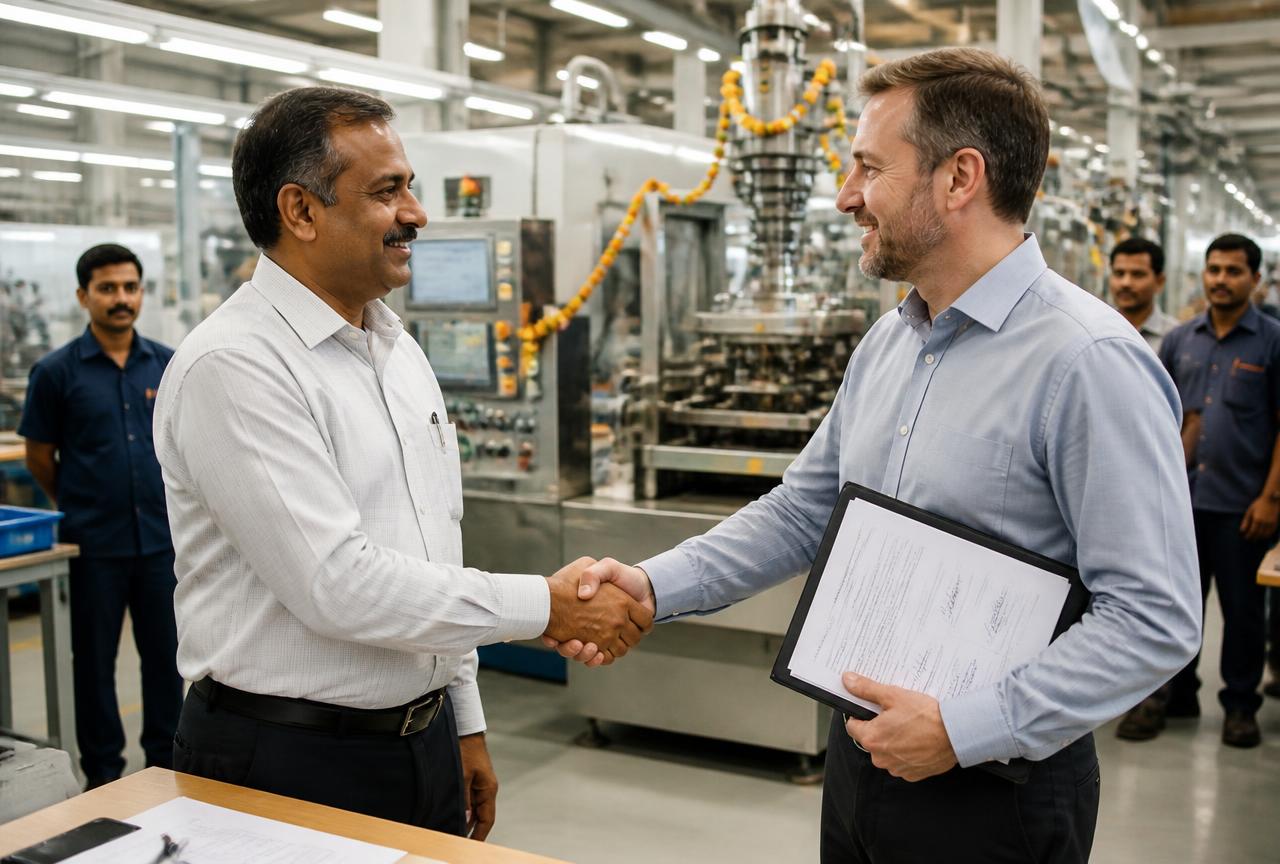
An Indian plant head shaking hands with a visiting product engineer beside a newly commissioned machine, the signed purchase order still in his other hand
One paying buyer ends the India debate at board levelA purchase order signed by a named Indian buyer, invoiced and collected on a real production line - median week 19, before any entity, hire or inventory commitment.

Measured impact

What the method has actually produced

Time saved against the entity-first route, conversion lift after the ICP reset, cash collected, and the multiple between value created and fees paid.

An Indian industrial and logistics district at dawn: trucks at loading docks, warehouses and a city skyline beyond

Where the work happens

India is not a market size. It is people who have to say yes.

Buyers, plant heads, procurement leads, distributors, service technicians. Every stage gate we pass is a set of humans who chose your product over the way they were doing it before.

Operators, distributors and buyers we work alongside in the field

The journey

Three stages, each with its own outcome metrics

Market creation, repeatability, then scale. Each stage has a commercial objective, a defined outcome metric set, and a stage gate that passes only on evidence.

0→1≈ 4 months

Create

Create the first real evidence of Indian demand and a validated India thesis - before entity, inventory or local hiring decisions.

Outcome metrics

  • First Indian ICP defined and validated with named accounts
  • Buying trigger and price metric proven in live conversations
  • Procurement and compliance path mapped end to end
  • Design partners or first pilot customers signed
  • First attributable collected revenue

Fee logic: Higher fixed fee plus a modest success fee on attributable collected revenue.

1→2≈ 6 months

Prove

Convert early traction into a repeatable sales and partner motion that does not depend on founder heroics.

Outcome metrics

  • Repeatable win rate and stated sales cycle time
  • Qualified pipeline coverage against a monthly target
  • Two or more productive channel or partner motions
  • Unit economics proven at the contribution-margin line
  • Playbook a local team can run without the founder

Fee logic: Monthly retainer plus success fee on attributable collected revenue or contribution margin.

2→x≈ 12 months

Scale

Expand regions, channels, team and country P&L on top of a proven motion.

Outcome metrics

  • Multiple regions live with local coverage
  • Partner network productivity per partner
  • Revenue run-rate and forecast accuracy
  • Country P&L visibility and contribution margin trend
  • India leadership and team in place

Fee logic: Larger retainer plus a lower-percentage success fee, because the revenue base and delivery scope are larger.

Field notes

What India actually says to a foreign product

These are the reactions we hear in the first weeks - before any of them becomes a purchase order.

Everyone sends me a deck. Nobody sends me a pilot I can run on one line, with a number I can take to my finance head.
Portrait of a plant head, industrial equipment buyer in PunePlant head, industrial equipment buyerPune
Your global price list is not my problem. Show me landed cost, duty, service turnaround - then I'll talk volumes.
Portrait of a procurement lead, mid-market manufacturer in ChennaiProcurement lead, mid-market manufacturerChennai
I'll stock it if the first thirty units move and someone picks up the phone when a customer walks back in.
Portrait of a distributor, tier-2 retail network in IndoreDistributor, tier-2 retail networkIndore

Composite field notes from discovery calls, paraphrased by role.

References

Every proof point on this page has a name behind it

Signed orders, gates that passed, dealers who reordered, a value multiple a CFO defends. Each quote belongs to the claim it is placed against.

Who this is for

Any product company with India as an open question

Product type drives the economics, the compliance path and the channel model. The method is the same.

Digital products

Software, platforms and digital products with traction abroad and no India revenue

Read the approach

Physical products

Hardware, devices, industrial, medtech, mobility and consumer products entering India

Read the approach

Hybrid products

Device plus software plus service revenue. Each revenue line is modelled on its own economics, then rolled up into a single India outcome view.

Result-value driven

Every engagement carries a value ledger

Not a slide at the end of the quarter. The value ledger is the primary report: what value was created, what it cost, and what the multiple is.

Attributable collected revenue

Cash actually received from registered opportunities, net of taxes, refunds, chargebacks and pass-through amounts.

Contribution margin created

For physical products, revenue less product cost, duties, freight, platform and channel margin, discounts, warranty and returns.

Fees paid

Retainer plus fixed fees plus success fees actually invoiced across the engagement.

Value multiple

Value created divided by fees paid - reported per phase and cumulatively.

Payback months

Months until cumulative value created exceeds cumulative fees paid.

Attribution, collection and permitted deductions are defined in the engagement before work begins.

Straight answers

What product companies ask before starting in India

Direct answers, with the page that carries the underlying evidence.

What is 1x2x.in?

1x2x.in is an India market-creation firm for product companies. It builds demand, first collected revenue and a repeatable commercial motion for digital, physical and hybrid products, then scales it pan-India.

It is not a consultancy that ends at a strategy deck, and not a distributor that resells your product. The team operates the India motion with you across three stages - 0→1 create, 1→2 prove, 2→x scale - and is paid partly on the value that motion creates.

See the operating system
What do 0→1, 1→2 and 2→x mean?

They are the three stage gates of an India engagement: 0→1 creates the first validated demand and revenue, 1→2 proves the motion repeats, and 2→x scales it across regions and channels.

Each gate passes on evidence, not on effort. 0→1 requires a named ICP with repeat qualified demand, documented willingness to pay and first attributable collected cash. 1→2 requires a motion another rep or partner can run. 2→x requires unit economics that hold at scale.

Stage gates in detail
How does 1x2x.in charge for India market creation?

Pricing is a retainer or fixed fee plus a success fee. The fee funds the operating team and research; the success fee follows attributable revenue only after cash is collected.

Success fees never trigger on bookings or invoiced pipeline. For physical products the success fee is calculated on contribution margin, not gross sales, so nobody is rewarded for unprofitable volume. Caps and step-downs are available where they make internal approval easier.

Commercial structure
How does 1x2x.in prove the engagement paid for itself?

Every quarter five ledger lines are reported: attributable collected revenue, contribution margin created, fees paid, value multiple and payback months.

The value multiple is value created divided by fees paid, reported per phase and cumulatively. If the multiple is not moving toward the agreed target, the scope changes - the reporting exists to make that conversation unavoidable.

The value ledger
What results have product companies seen in India?

Portfolio medians across engagements that reached the stated gate include roughly 19 weeks to first collected order and about 5.6× value created per fee paid.

Figures are rounded medians, not best cases, and the underlying contracts, invoices and ledgers are reviewed under NDA. Named before-and-after narratives with their measured numbers are published as case studies.

Case studies
How long does it take to reach first revenue in India?

The 0→1 stage runs about four months and targets the first attributable collected revenue rather than a launch date.

Speed depends on purchase complexity: a self-serve digital product can transact in weeks, while a certified industrial product may need testing, approvals and a channel partner before the first invoice is even possible.

Programs and durations
Does this work for physical products as well as software?

Yes. Digital, physical and hybrid products are all in scope, with different work: software needs pricing, procurement and pipeline; physical products add import duty, certification, logistics, channel margin, service and returns.

Because physical margin structures differ so sharply from software, physical engagements are priced and reported on contribution margin created rather than revenue.

For physical products
How is this different from a market-entry consultant or a distributor?

A consultant delivers analysis and a distributor buys and resells. 1x2x.in operates your India motion, is measured on collected revenue and margin created, and hands the motion over to your team.

The engagement ends with your own team, partners and playbooks running the motion - including the ICP definition, price metric, procurement path and partner set that produced the revenue.

How we operate

The value that drives the work

India market creation for product companies - priced, gated and reported on the value it created

Not a retainer that runs forever, and not a market-entry report. One operating system where the fee, the go/no-go decision and the closing report all point at the same number: value created for your product in India.

Retainer plus success fee

A predictable retainer covers the operating work. The success fee is earned only against value that lands - revenue booked, pipeline qualified, cost avoided.

Evidence-based stage gates

0→1, 1→2 and 2→x each open on evidence, not optimism. If a gate does not clear, we stop and say so before more money moves.

Reported on value created

Every engagement closes on a value ledger: what was claimed, what was verified, how it was attributed, and what it cost to get there.

Test whether your product has a credible India wedge

A focused 30-minute discussion about your product, your current markets and the likely India wedge. No pitch deck, no generic market-size slides.